Trust can be the key to high performance like a fresh wind filling our sail or act as overhead that slows us down no matter how hard we try, like dragging an anchor. In my recent series of blog articles on how to use lean concepts for high performance teams, you may be thinking trust is a weird place to go next. To start with I want you present a cause of effects diagram. Systems thinkers use this technique to visualize patterns of causality. Systems Thinking is an important topic for later. But a key element if that Systems Thinkers think systems (not good or bad people) cause behavior and the best was to change behavior is to change the system. So take a look at this;
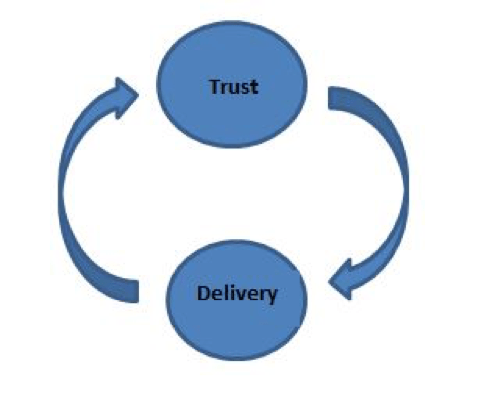
This is pretty simple. Delivery causes Trust to build and Trust makes Delivery easier. Slow or no delivery can lower or eliminate trust. So now let’s add some things from Lean Agile that we know cause higher delivery throughput.
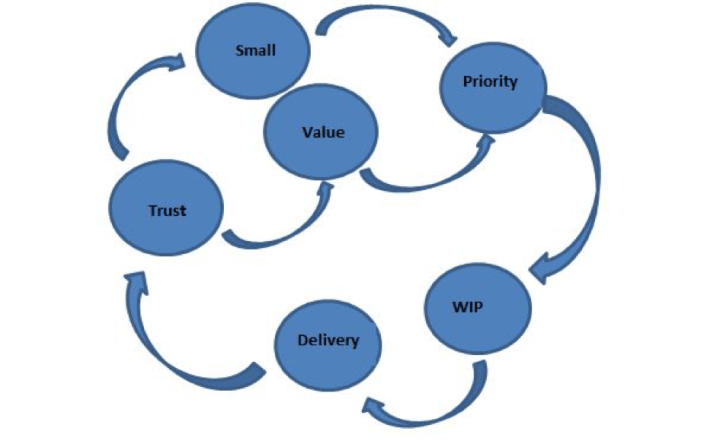
We know from Little’s Law (and the penny game) that in any system, WIP (work in progress or batch of) has a direct and profound effect on delivery rate. We also saw how priority setting using WSJF can help us get the most out of what gets into WIP. Lastly we saw how having work broken down to small pieces and knowing the value is key to priority setting.
Consider the beginning of most projects when trust of planners and deliverers is generally low. Often, a planner’s low trust drives work units bigger because they have not seen anything come out so we better ask for it all. Sometimes a planner knows or has been told the priority so there is no need for anyone on the delivery side to understand the value of the ask. As a result, size and priorities are not set to maximize delivery throughput. This can create a vicious cycle of self-fulfilling prophesy; I knew I shouldn’t trust them, they can’t delivery anything. This often drives WIP even bigger. Often as a coach I hear “If I set expectations high they will rise to meet them”. You can see this is self-undermining.
Imagine a parallel universe where we view planning and delivery as one thing to be done in a collaborative spirit rather than contracted with hand offs. Let’s call this Agile World. In this world the Planner on the team (let’s call that person the Product Owner or PO) understands that the team works best when the pieces are small and everyone understands the value. The PO willingly splits work even smaller than they are comfortable with; this usually gives the PO the willies (What the heck are the Willies). The priorities get set with the most valuable and smallest at the top. Then just the top of the backlog gets worked on. The team is 100% dedicated and focused from all distractions. The team delivers the most valuable things possible at the highest sustainable throughput. This leads to more trust and collaboration and less urge to contract and less PO willies.
Now consider how this trust system effects dependencies. If you are on a team that is dependent on another team delivering, you are in the same system. So would overstating the value or priority help you? Would asking for more than the minimum you need help you? What if you collaborated to find a way to breaking into even smaller pieces? What if there was mind-share about how to prioritized so teams could align priorities around customer value and delivery throughput?
Thoughts?

